

Skip to content
Summits & ConferencesIn person3 days

5th Annual Academic Integrity & Assessments in an AI World Africa 2027

Africa 2027

“Harnessing the educational benefits of AI while protecting academic honesty”

A pre-conference assessment design workshop and two conference days on protecting academic honesty, fairness and the credibility of qualifications in the generative AI era.

Scheduled dates (1)

  • 17 - 19 March 2027

    The Maslow Hotel, Sandton

    Johannesburg, South Africa

    In personRegister →

Overview

Why this programme

The challenges of academic integrity have changed significantly with technology and generative artificial intelligence. Generative AI and digital tools have fundamentally disrupted academic integrity and assessment in higher education, making traditional policing and detection-first strategies largely obsolete.

AI tools can support students by explaining complex concepts, generating ideas, improving academic writing, translating languages and providing personalised learning assistance. The same tools make recall tasks, basic essays and standard homework easy to outsource. Text-spinners, AI paraphrasers and humaniser tools bypass plagiarism and AI-detection software, detectors produce false positives and false negatives, and contract cheating and ghost-writing are becoming more frequent.

In the African context these issues matter even more. Limited internet access, unequal access to AI tools, large classes, inadequate infrastructure and unclear AI policies all complicate the responsible use of technology.

This programme is about harnessing the educational benefits of AI while protecting academic honesty, fairness, assessment validity and the quality of qualifications. The goal is not to eliminate AI from education, but to ensure that AI strengthens learning without replacing the knowledge, skills, judgement and academic responsibility that education is intended to develop.

Programme

  1. 01

    Day 1 · 17 March - Pre-conference workshop: From Assessment Task to Defensible Evidence, a hands-on assessment design workshop in the Gen AI era (facilitated by Dr VJ Maseko)

    • Workshop overview: the AI-Powered Bloom's Taxonomy Framework Plus (ABTF+), assessment challenges in the generative AI era, applying the six ABTF+ dimensions to authentic assessment design
    • Session 1 - Diagnose existing assessments: evaluate tasks, identify weaknesses and potential AI misuse, test whether tasks demonstrate genuine understanding
    • Session 2 - Reconstruct assessment tasks: align with learning outcomes, build in higher-order thinking and problem-solving, design authentic discipline-based activities
    • Session 3 - Specify AI-use conditions: define permitted, conditional and prohibited AI use, student AI-use guidelines and AI disclosure statements
    • Session 4 - Build defensible assessment evidence: drafts, source verification, reflection and oral explanations, aligned rubrics and performance criteria
    • Session 5 - Quality assurance and moderation: peer review of redesigned assessments, validity and alignment checks, moderation checklists
    • Live demonstrations with ABTF+ GPT: AI-assisted assessment diagnosis and redesign, AI-developed rubrics, verifying AI recommendations, keeping human oversight. Guiding principle: Human Directs, AI Assists, Human Decides
    • You leave with a redesigned assessment task, AI-use guidelines and disclosure statement, an assessment evidence framework, a draft rubric and a peer-review and moderation checklist. Please bring a laptop and, where available, existing assessment tasks and learning outcomes. No coding experience required
  2. 02

    Days 2 & 3 · 18-19 March - Conference sessions 1 to 10

    • Keynote address: What are the new and emerging trends in academic misconduct? AI-giarism and ghostwriting, hallucinations and false citations, unreliable detection tools, institutional policy gaps
    • Panel discussion: The global policy dilemma in academic integrity and assessment - balancing ethical enforcement, equitable access and technological change in Africa
    • AI tools in examinations and assessments: the credibility of qualifications, a South African case study
    • Panel discussion: Major challenges to academic integrity in Africa in the AI era
    • The challenges of traditional assessment: moving away from rote memorisation and unreliable AI detection toward process-oriented learning
    • Shifting toward promoting and evaluating higher-order thinking, creativity and ethical reasoning in the AI era
    • Panel discussion: Ensuring academic integrity while embracing technology
    • Equipping educators and transforming academic assessments in the AI era: from black-box to glass-box grading, modelling responsible use, authentic assessment design
    • Using AI to support assessment and grading: first-pass scores, structured feedback and reduced grading workloads
    • How AI grading and AI assessment systems work: essential best practices and guardrails
  3. 03

    Conference sessions 11 to 19

    • Evolving solutions and new directions in academic assessment: process-oriented learning, authentic and contextualised tasks, human-AI collaboration
    • Emerging solutions and strategic shifts in academic integrity and assessment in the AI era
    • Academic integrity in higher education: shifting from policing and punishment to a developmental, AI-integrated model ('Educate, Enable, Expect')
    • Building academic integrity and capacity in digital assessment in higher education, a USA case study
    • Which traditional forms of academic misconduct should educators continuously look out for? Self-plagiarism, AI-assisted patchwriting, student collusion and data plagiarism
    • Panel discussion: Academic integrity in the future - moving beyond detection tools to address assessment challenges in Africa in the AI era
    • Designing assessment that promotes deep learning and academic integrity: scaffolding, Bloom's taxonomy, oral and reflective components, lower-stakes frequent assessment
    • Aligning university assessment standards with the ethical AI skills expected by employers
    • Panel discussion: Strategies for addressing academic integrity and assessment challenges in Africa in the AI era

Featured speakers

Who you'll hear from

Confirmed at time of publishing. Speakers and topics may be substituted where circumstances beyond our control require it.

Dr VJ Maseko

Dr VJ Maseko

Educational Leader, Scholar and Author | Developer of ABTF+ | CEO

Unique Solutionz

Workshop facilitator

Dr Oscar Eybers

Dr Oscar Eybers

Senior Lecturer - Unit for Academic Literacy

University of Pretoria
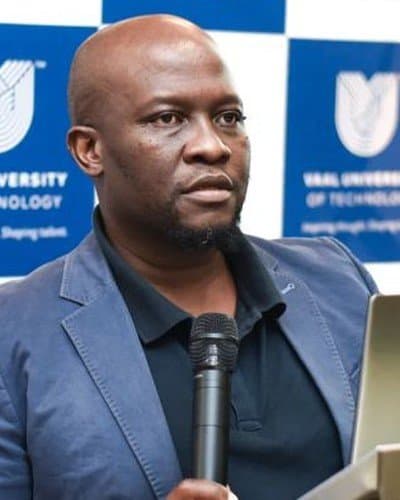
Dr Luyanda Marhaya

Dr Luyanda Marhaya

Peer Academic for Quality Reviews

Vaal University of Technology (VUT)

Dr Shahiem Patel

Dr Shahiem Patel

Academic Dean

Regent Business School

Anne Verhoef

Anne Verhoef

Professor - Philosophy | Director - Artificial Intelligence Hub

North-West University

Paul Esselaar

Paul Esselaar

Attorney and Notary

Esselaar Attorneys

Prof Arthur James Swart

Prof Arthur James Swart

Associate Professor

Central University of Technology

Dr Chris-Mari Le Hanie

Dr Chris-Mari Le Hanie

Subject Head: Comparative Education, History of Education, Curriculum Studies and Philosophy of Education

Akademia MSW

Prof Divya Singh

Prof Divya Singh

Senior Research Academic

STADIO

Jamie Rood

Jamie Rood

Co-Founder

Marking.ai

Albert Kagande

Albert Kagande

Postdoctoral Fellow - Development Studies

Nelson Mandela University

Carmen Gunkel

Carmen Gunkel

Head: Academic

Emeris

Brochure

Ask us for the full programme

The printed brochure carries the complete agenda, the speaker line-up, pricing and the registration form - everything you need to put 5th Annual Academic Integrity & Assessments in an AI World Africa 2027 in front of a budget holder. Tell us where to send it and we will.

  • Full 3-day agenda, session by session
  • Pricing, payment terms and the registration form
  • Venue, dates and delegate logistics

We'll email the brochure to you shortly. We use your details only to answer questions about this programme - see our privacy notice for how we handle personal information under POPIA.

Also in this stream

Summits & Conferences

11MAR
Summits
In person

Workplace 2027: The Advanced HR & Labour Relations Conference

“Future-Proofing HR: Navigating Labour Law Reform, AI Disruption & Workforce Transformation…”

Two intensive days of labour law reform, AI governance and workforce strategy for HR and labour relations professionals, closing with a half-day workshop on CCMA and disciplinary hearings.

Dates
11 - 12 March 2027
Venue
Capital Empire Hotel, Sandton, Johannesburg, South Africa
FromR 7 500ex VAT
View & register →
21APR
Summits
In personEarly bird

Harmonizing African Immigration for Regional Growth Africa 2027

“Enhancing security, facilitating free movement and driving regional integration”

Three days at Sun City on immigration policy, legal harmonisation, border security and the future of mobility across the continent, proudly supported by Africa Pensions.

Dates
21 - 23 April 2027
Venue
Sun City Convention Centre, Sun City, South Africa
FromR 12 990ex VAT
View & register →
21JUL
Summits
In person

5th Annual TVET & Higher Education Conference-Expo 2027

“From Crisis to Opportunity: Finding Solutions for a PSET Sector in Transition”

A Pre-Conference Leadership Gala, two conference days, a solutions exhibition and an Innovation & Product Demonstration Theatre for the leaders shaping post-school education and training.

Dates
21 - 23 July 2027
Venue
Gallagher Convention Centre, Johannesburg, South Africa
Rates on application
View & register →

Ready to secure your seat?

Register online with card or Instant EFT, or request an invoice for bank transfer.

Register now